7.1 A crystal on paper
L1 Narrative
In 1801 Charles Hatchett found an unknown metal in a mineral from North America and called it columbium [III. An analysis 1802 rec]. In 1802 Anders Ekeberg named another metal tantalum, after Tantalus of Greek myth, who stood in water he could never drink; the oxide would not dissolve even in excess acid [Ekeberg 1802 P; Rose 1844 rec]. In 1809 William Hyde Wollaston argued the two were the same element [XV. On the 1809 rec], and chemists accepted that for 35 years.
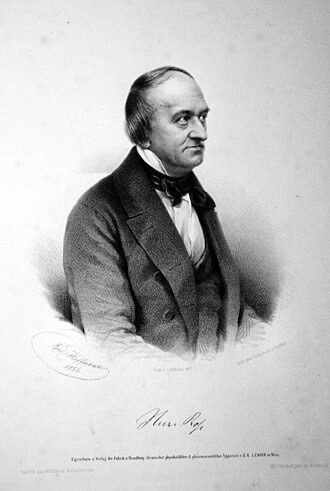
In 1844 Heinrich Rose in Berlin showed that tantalite from Bavaria held a second metal. He called it niobium, after Niobe, daughter of Tantalus, “to indicate the similarity” with tantalum [Rose 1844 rec]. In 1846 he named a third, pelopium, after Niobe's brother Pelops [Rose 1846 rec]; it was niobium again. In 1818 Berzelius had already named lithium from the Greek for stone, because his student Arfwedson found it in a mineral [Arfwedson 1818 rec; Berzelius 1818 rec]. So LiNbO3 is, by name, stone and Niobe; its sibling LiTaO3 is stone and Tantalus.
The earliest report of the compound found is a 1928 Oslo doctoral thesis by W. H. Zachariasen, a survey of oxide crystal structures [Zachariasen 1928 P]. In 1949 Bernd Matthias and Joseph Remeika at Bell Labs reported that single crystals of LiNbO3 and LiTaO3 are ferroelectric: each carries a built-in electric polarization that an applied field can reverse [Matthias & Remeika 1949 rec]. In 1958 Reisman and Holtzberg mapped how lithium oxide and niobium oxide melt together [Reisman & Holtzberg 1958 rec].
+-- ------ niobium, Rose 1844 | = Hatchett 1801 +-- ----- Rose 1846 (= Nb) +-- tantalum, Ekeberg 1802 ---- lithium, Arfwedson 1818 Li + Nb ---- stone and Niobe Li + Ta ---- stone and Tantalus
“Ich nenne dasselbe Niobium und sein Oxyd Niobsaure, von Niobe, der Tochter des Tantalus, um durch den Namen die Aehnlichkeit ... anzudeuten”
Gloss: I name it niobium and its oxide niobic acid, after Niobe, the daughter of Tantalus, to indicate by the name the similarity ...
Rose showed that tantalite from Bavaria held a second metal.
Ann. Phys. 139, pp. 335-336 · Rose 1844 rec; Rose 1844 rec
“Ich nenne dasselbe Niobium und sein Oxyd Niobsaure, von Niobe, der Tochter des Tantalus, um durch den Namen die Aehnlichkeit ... anzudeuten”
I name it niobium and its oxide niobic acid, after Niobe, the daughter of Tantalus, to indicate by the name the similarity ...
Rose showed that tantalite from Bavaria held a second metal.
Ann. Phys. 139, pp. 335-336 · Rose 1844 rec; Rose 1844 rec

L2 Numbers and mechanisms
The naming sentence. Rose 1844, Ann. Phys. 139, pp. 335-336: “Ich nenne dasselbe Niobium und sein Oxyd Niobsaure, von Niobe, der Tochter des Tantalus, um durch den Namen die Aehnlichkeit ... anzudeuten” [Rose 1844 rec]. The paper was read to the Berlin Academy on 1844-10-31 [Rose 1844 rec]. Pelopium: Rose 1846, Ann. Phys. 145, p. 119, “von Pelops, dem Sohne des Tantalus, und dem Bruder der Niobe”; read 1846-07-16 [Rose 1846 rec; Rose 1846 rec].
Untangling. Rose later recognized that his “pelopic” and “niobic” acids held the same metal; Marignac (1866) identified the white chloride as NbOCl3 and traced Rose's errors to the constant association of Nb with Ta [Marignac 1866 rec]. The name niobium was chosen internationally in 1949 and accepted by IUPAC in 1950 [Rayner-Canham & Zheng 2008 S; van der Krogt 2026 S].
Lithium. Arfwedson's paper (Afhandlingar 6, Stockholm 1818) states that Berzelius proposed “Lithion” from the Greek for stone because the alkali was first found in the mineral kingdom; the petalite came from the Uto iron mine [Arfwedson 1818 rec]. Berzelius announced it in a letter dated 1818-02-09 [Berzelius 1818 rec]. The discovery is commonly dated 1817 [Weeks 1932 P].
Ferroelectric, not ilmenite. Matthias and Remeika titled their letter “Ferroelectricity in the ilmenite structure” and wrote that Zachariasen had described LiNbO3 (as “LiCbO3”) “as belonging to the ilmenite structure, which is centro-symmetric” [Matthias & Remeika 1949 rec]. A centrosymmetric crystal cannot be ferroelectric, so the observation itself flagged the structural label. The 1966 Bell Labs X-ray and neutron studies fixed the structure as R3c [Abrahams et al. 1966a rec; Abrahams et al. 1966b rec]; the standard reading is that LN shares ilmenite's oxygen framework but orders its cations differently along c [Abrahams et al. 1966a P]. They also report that ceramics “show hardly any effect”, which is why single crystals mattered from the start [Matthias & Remeika 1949 rec].
Composition. Reisman and Holtzberg mapped the Li2O-Nb2O5 system in 1958 [Reisman & Holtzberg 1958 rec]. Lerner, Legras and Dumas showed in 1968 that commercial crystals are Li-deficient [Lerner et al. 1968 rec]. Carruthers et al. located the congruent composition at 48.6 mol% Li2O by 93Nb NMR and Curie-temperature shifts, with a room-temperature solid solution of 48-50 mol% Li2O [Carruthers et al. 1971 rec]. A melt at the congruent point freezes to a crystal of the same composition, so a boule is uniform end to end; that crystal is lithium-poor.
Czochralski's method. “Ein neues Verfahren zur Messung der Kristallisationsgeschwindigkeit der Metalle” measured the maximum speed at which a thin crystal thread can be drawn continuously from its melt, held in a charcoal crucible [Czochralski 1918 rec]. Received 1916-08-19, issued 1917-04-24 in volume 92, which is dated 1918.
L3 Sources and status
| Claim | Source | Status |
|---|---|---|
| Columbium named 1801 (read 1801-11-26), printed 1802 | III. An analysis 1802 (scan p. 65) | rec |
| Tantalum named 1802 for the oxide's failure to take up acid | Ekeberg 1802 via Rose 1844 p. 318, XV. On the 1809 | P |
| Niobium named 1844; pelopium 1846 | Rose 1844, Rose 1846, both Berlin Bericht scans | rec |
| Lithium from Greek “stone”; announced 1818 | Arfwedson 1818 p. 153, Berzelius 1818 | rec |
| LiNbO3 in Zachariasen 1928 | citing papers only (Matthias & Remeika 1949, Abrahams et al. 1966a, Bartasyte et al. 2017) | P |
| Ferroelectricity in LiNbO3, single crystals, 1949 | Matthias & Remeika 1949 (full scan read) | rec |
| Growth method of the 1949 crystals | not stated in the 1949 letter | open |
| Congruent 48.6 mol% Li2O | Carruthers et al. 1971 abstract | rec |
| Czochralski paper issued 1917-04-24 | issue scan, Czochralski 1918 | rec |
| “Pen dipped in molten tin” (1916) | Malecka 2013, anecdote | S |
Niobium is 1844; secondary sources that give 1846 merge the niobium and pelopium papers (English Wikipedia text cites the 1844 paper but writes 1846) [Rose 1844 rec; Rose 1846 rec].
References
- Philosophical Transactions of the Royal Society of London 92 49-66 (1802). III. An analysis of a mineral substance from North America, containing a metal hitherto unknown. Issued 1802-12-31. doi:10.1098/rstl.1802.0005
- Anders Gustaf Ekeberg, Kongl. Vetenskaps Academiens Nya Handlingar 68 (1802). Paper naming tantalum (as cited). Issued 1802
- Heinrich Rose, Annalen der Physik 139 317-341 (1844). Ueber die Zusammensetzung der Tantalite und ein im Tantalite von Baiern enthaltenes neues Metall. Issued 1844-01. doi:10.1002/andp.18441391006
- Philosophical Transactions of the Royal Society of London 99 246-252 (1809). XV. On the identity of Columbium and Tantalum. Issued 1809-12-31. doi:10.1098/rstl.1809.0017
- Rose, Annalen der Physik 145 115-141 (1846). Ueber ein zweites im Tantalit (Columbit) von Baiern enthaltenes neues Metall. Issued 1846-01. doi:10.1002/andp.18461450911
- Johan August Arfwedson, Afhandlingar i Fysik, Kemi och Mineralogi 6 145-172 (Berzelius addendum 173-176) (1818). Undersokning af nagra vid Uto jernmalmsbrott forekommande fossilier, och af ett deri funnet eget eldfast Alkali. Issued 1818. archive.org/details/bub_gb_71QrAAAAcAAJ
- Jons Jacob Berzelius, Annales de Chimie et de Physique 7 199-201 (1818). Letter to C. L. Berthollet announcing a new alkali (dated 1818-02-09). Issued 1818. archive.org/details/s3id13207740
- W. H. Zachariasen, Skrifter utgitt av det Norske Videnskaps-Akademi i Oslo, I. Mat.-Naturv. Klasse 1928, No. 4 165 pp. (1928). Untersuchungen uber die Kristallstruktur von Sesquioxyden und Verbindungen ABO3. Issued 1928
- Matthias & Remeika, Physical Review 76 1886-1887 (1949). Ferroelectricity in the Ilmenite Structure. Issued 1949-12-15. doi:10.1103/physrev.76.1886.2
- Reisman & Holtzberg, Journal of the American Chemical Society 80 6503-6507 (1958). Heterogeneous Equilibria in the Systems Li2O-, Ag2O-Nb2O5 and Oxide-Models. Issued 1958-12. doi:10.1021/ja01557a010
- Heinrich Rose, Bericht uber die zur Bekanntmachung geeigneten Verhandlungen der Koniglich Preussischen Akademie der Wissenschaften zu Berlin, 1844 361-364 (1844). Ueber die Zusammensetzung der Tantalite (session of 1844-10-31). Issued 1844. archive.org/details/BerichtUberDieZurBekanntmachung1844
- Heinrich Rose, Bericht ... Akademie der Wissenschaften zu Berlin, 1846 229-230 (1846). Ueber ein neues, im Tantalit (Columbit) von Baiern enthaltenes Metall (session of 1846-07-16). Issued 1846. archive.org/details/BerichtUberDieZurBekanntmachung1846
- Jean Charles Galissard de Marignac, Annales de Chimie et de Physique, 4e serie 8 5-75 (1866). Recherches sur les combinaisons du niobium. Issued 1866. archive.org/details/s696id13664940
- Geoff Rayner-Canham & Zheng Zheng, Foundations of Chemistry 10 13-18 (2008). Naming elements after scientists: an account of a controversy. Issued 2008-04. doi:10.1007/s10698-007-9042-1
- Elementymology and Elements Multidict: Niobium (2026). Elementymology and Elements Multidict: Niobium. Issued 2026. www.vanderkrogt.net/elements/element.php?num=41
- Mary Elvira Weeks, Journal of Chemical Education 9 1035 (1932). The discovery of the elements. IX. Three alkali metals: Potassium, sodium, and lithium. Issued 1932-06. doi:10.1021/ed009p1035
- Abrahams et al., Journal of Physics and Chemistry of Solids 27 997 (1966). Ferroelectric lithium niobate. 3. Single crystal X-ray diffraction study at 24 C. Issued 1966-06. doi:10.1016/0022-3697(66)90072-2
- S.C. Abrahams et al., Journal of Physics and Chemistry of Solids 27 1013-1018 (1966). Ferroelectric lithium niobate. 4. Single crystal neutron diffraction study at 24°C. Issued 1966-06. doi:10.1016/0022-3697(66)90073-4
- Lerner et al., Journal of Crystal Growth 3-4 231-235 (1968). Stoechiométrie des monocristaux de métaniobate de lithium. Issued 1968-01. doi:10.1016/0022-0248(68)90139-5
- Carruthers et al., Journal of Applied Physics 42 1846-1851 (1971). Nonstoichiometry and Crystal Growth of Lithium Niobate. Issued 1971-04-01. doi:10.1063/1.1660455
- J. Czochralski, Zeitschrift für Physikalische Chemie 92U 219-221 (1918). Ein neues Verfahren zur Messung der Kristallisationsgeschwindigkeit der Metalle. Issued 1918-11-01. doi:10.1515/zpch-1918-9212
- Ausrine Bartasyte et al., Advanced Materials Interfaces 4 1600998 (2017). Toward High‐Quality Epitaxial LiNbO 3 and LiTaO 3 Thin Films for Acoustic and Optical Applications. Issued 2017-04. doi:10.1002/admi.201600998
- K. Malecka, ACADEMIA (2013). Article on Jan Czochralski (ACADEMIA, Polish Academy of Sciences magazine). Issued 2013
Events of 7.1
| Date | Event | Who | Ref | St |
|---|---|---|---|---|
| 1801-11-26 | Hatchett reports a new metal in a North American mineral and names it columbium | Charles Hatchett | DOI | rec |
| 1802 | Ekeberg names tantalum after Tantalus | Anders Gustaf Ekeberg | - | P |
| 1809 | Wollaston argues columbium and tantalum are the same element | William Hyde Wollaston | DOI | rec |
| 1818-02-09 | Lithium announced: Arfwedson finds a new alkali in petalite; Berzelius names it from Greek lithos | Johan August Arfwedson, Jons Jacob Berzelius | URL | rec |
| 1844-10-31 | Heinrich Rose names niobium after Niobe, daughter of Tantalus | Heinrich Rose | DOI | rec |
| 1846-07-16 | Rose names a second 'new metal' pelopium after Pelops, Niobe's brother | Heinrich Rose | DOI | rec |
| 1866 | Marignac settles niobium chemistry; pelopium and 'ilmenium' are not new elements | Jean Charles Galissard de Marignac | URL | rec |
| 1917-04-24 | Czochralski publishes the crystal-pulling method (as a way to measure metal crystallization speed) | Jan Czochralski | DOI | rec |
| 1928 | Zachariasen's structure survey of sesquioxides and ABO3 compounds lists LiNbO3 | W. H. Zachariasen | - | P |
| 1949 | The name niobium chosen internationally over columbium | DOI | S | |
| 1949-12-15 | Matthias and Remeika find ferroelectricity in LiNbO3 and LiTaO3 | B. T. Matthias, J. P. Remeika | DOI | rec |
| 1958-12 | Li2O-Nb2O5 phase diagram | Arnold Reisman, Frederic Holtzberg | DOI | rec |